Table of contents
Tourism marketers have long treated social platforms as a “top of funnel” channel, good for inspiration but hard to connect to bookings, yet the last two years have shown the opposite: discovery, evaluation, and conversion now happen inside the same apps. With travel demand normalising after the pandemic surge and travellers comparing prices in real time, platforms such as TikTok, Instagram, WeChat, and Xiaohongshu are increasingly shaping where people go, which hotels they trust, and how fast they commit. The influence is measurable, and it is quietly rewriting acquisition strategies across the industry.
From wanderlust to booking, in one scroll
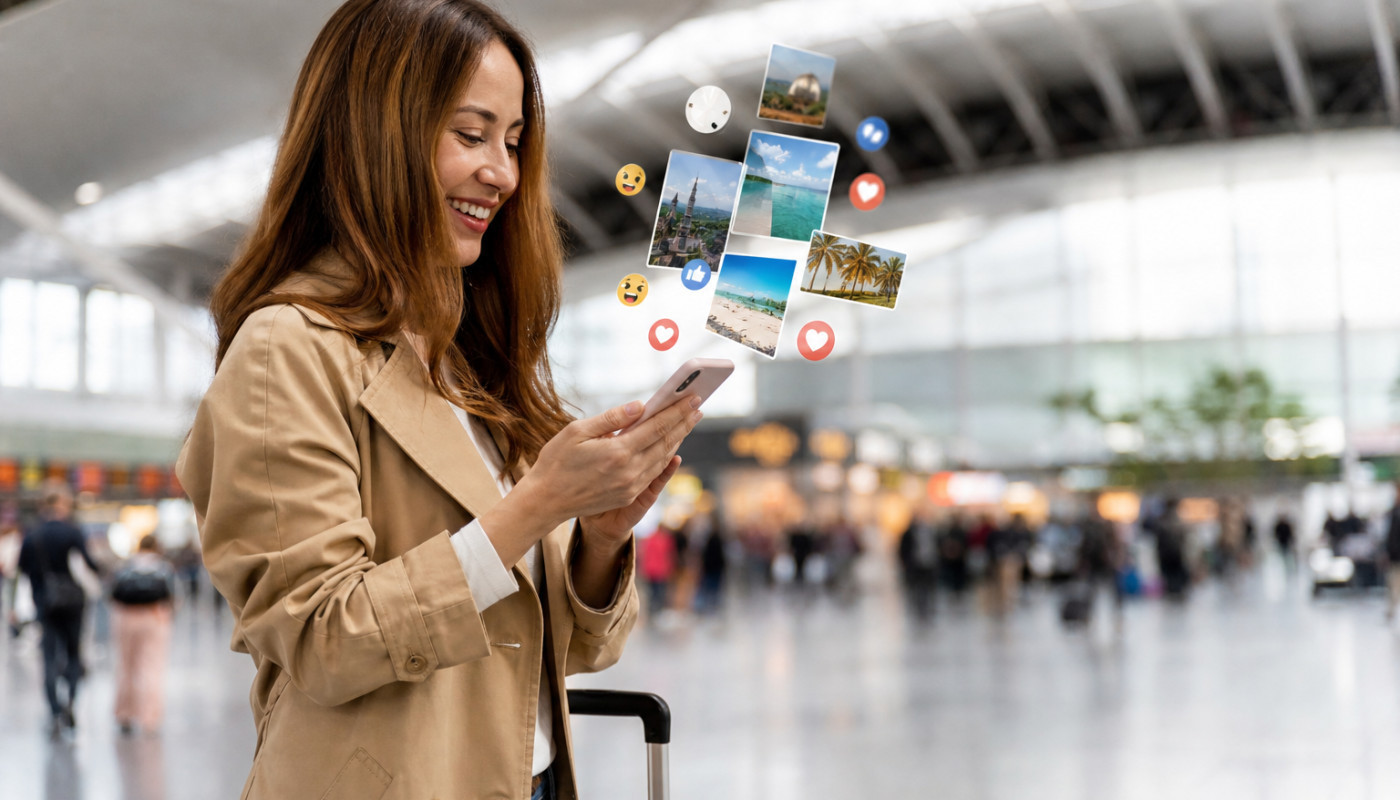
Travel used to be planned in tabs; it is now planned in feeds. The shift is not merely cultural, it is structural: social platforms have added shopping features, native lead forms, and integrated messaging, and consumers have grown comfortable moving from inspiration to transaction without leaving the app. The result is that “consideration” has been compressed, and destinations that master short-form video and creator partnerships can shorten the path to purchase by days, sometimes weeks.
The numbers behind this change are hard to ignore. TikTok says users are heavily influenced by the platform when making purchase decisions, and travel has become one of its most visible categories, powered by search-like behaviour inside the app. Google has also acknowledged the trend from the other side: internal research it has cited in recent years shows younger users increasingly turning to social apps for discovery, including local places and travel ideas, rather than starting with a traditional search engine. In practice, that means a beach in Albania, a neighbourhood in Seoul, or a museum in Mexico City can move from obscurity to “must-see” status after a handful of viral posts, and the spike can translate into bookings if the next step is frictionless.
Conversion is not driven by virality alone, however, and this is where many brands still fall short. A spectacular reel can fill a comment section with questions, yet if the operator takes days to reply, if the booking link is buried, or if the offers are not localised, the momentum evaporates. In a feed environment, speed and clarity convert: clickable calls to action, pinned answers, prices shown upfront, and customer support that feels immediate. For hotels and tour operators, the practical playbook looks less like classic brand advertising and more like performance marketing, with creative that is native, measurable, and designed to capture demand at the moment it appears.
Why travel brands still misread social data
Are marketers tracking the wrong signals? Too often, yes. Likes, views, and follower counts remain the most reported metrics in travel campaigns, partly because they are easy to obtain and flattering to present, yet they frequently fail to predict revenue. What matters in tourism is intent, and intent shows up elsewhere: saves, shares, profile visits, link clicks, message starts, and the quality of inbound questions. A post that generates fewer views but triggers a wave of “How much is it?” and “Is there availability in August?” can be worth more than a viral clip that produces only emojis.
This mismatch has consequences when budgets are tight. The World Travel & Tourism Council has repeatedly underlined the sector’s economic weight, with trillions of dollars in global contribution and hundreds of millions of jobs, but the competitive landscape is fragmented, and customer acquisition costs rise quickly when brands chase attention instead of demand. Meanwhile, platforms have become more complex measurement environments: privacy changes have reduced the granularity of third-party tracking, and attribution windows differ from one app to another, making it harder to connect a video view to a booking that happens days later on a different device.
The better approach looks more like newsroom discipline than marketing theatre: define the outcome first, then build measurement backwards. For a destination marketing organisation, that might mean tracking referral traffic to partner pages and monitoring booking intent in key markets; for an airline, it might mean app installs and completed searches; for a tour company, it might be qualified leads in messaging with dates, group size, and budget. Incrementality tests, geo-lift experiments, and time-based comparisons are no longer reserved for the biggest platforms, and even mid-sized operators can run controlled trials, for example by rotating creative across comparable audiences, then comparing conversion rates and basket sizes.
There is also a content-data loop that many travel players overlook. Social is not only distribution, it is research. Comment threads reveal objections about visas, language barriers, dietary needs, safety perceptions, or hidden fees, and those insights can be fed directly into product design, FAQ structure, and pricing transparency. In an era where trust is a competitive advantage, the brands that listen hardest often sell easiest, because their content answers the questions travellers are already asking, in the words they actually use.
China’s social ecosystem changes the rules
Ignore China’s platforms, and you misunderstand modern tourism. Even with international travel still stabilising compared with pre-pandemic highs, China remains central to global travel strategy, not only because of outbound potential, but because its digital ecosystem operates with different mechanics. WeChat blends messaging, payments, mini-programs, and customer service, while Xiaohongshu mixes lifestyle discovery with detailed recommendations, and Douyin, the domestic version of TikTok, has matured into a commerce engine that can move consumers from content to purchase at speed.
For travel brands, the implication is simple and demanding: localisation is not a translation exercise, it is an operational commitment. Chinese travellers often expect fast responses in-app, price clarity in RMB or easily convertible terms, and proof points that feel native, such as KOL endorsements, user-generated itineraries, and platform-specific ratings. They also react strongly to practical travel constraints, from connectivity and payment acceptance to family-friendly logistics, and those concerns surface immediately in comments and private messages. A campaign that looks polished by Western standards can underperform if it fails to match local behaviours, platform norms, and seasonal planning cycles.
This is where specialist expertise can become decisive, particularly for brands that need to build demand without wasting spend. Working with partners who understand media buying, creative codes, and conversion flows inside the Chinese ecosystem can help reduce friction, from setting up official accounts and mini-program entry points to designing content that drives qualified leads rather than passive impressions. For organisations trying to navigate that landscape, resources such as CTA agency in Shanghai outline how China-focused digital strategies are structured, including the platform choices and funnel mechanics that typically determine whether interest becomes revenue.
The stakes are not theoretical. When a destination becomes “trendable” on Xiaohongshu, the surge can be immediate, and it can overwhelm suppliers that are not prepared with Chinese-language support, payment options, and inventory controls. Conversely, when the customer journey is built properly, conversion can be remarkably efficient, because the platforms are designed to keep users inside a single environment, reducing the drop-off points that plague cross-site funnels. In short: the same social-to-sale story is playing out globally, but in China it is more integrated, and therefore less forgiving.
The conversion playbook: trust, speed, proof
Want more bookings, not just buzz? The winning social strategies in tourism are converging around three principles: trust, speed, and proof. Trust comes from consistency and transparency, including clear cancellation policies, real guest reviews, and content that shows what the experience truly looks like, not only the highlight reel. Speed means responding quickly, simplifying the path to purchase, and removing avoidable steps, especially on mobile where most discovery begins. Proof is the social validation that reassures hesitant travellers, whether through creator partnerships, customer testimonials, or credible third-party coverage.
That playbook is increasingly being engineered through operational details. Many brands now treat messaging as a sales channel, not a support add-on, staffing it with trained agents who can answer pricing and availability questions in minutes, not days. Others are building “bookable content” with links that land on a pre-filled itinerary page, and they are using retargeting to bring back viewers who saved a post or watched a video to the end, signals that often correlate with intent. Even creative choices are being optimised for conversion: including prices early, showing transport time between attractions, highlighting what is included, and addressing common objections in the first seconds rather than waiting for a caption.
Measurement is evolving alongside tactics. Instead of celebrating reach, more teams are tracking blended customer acquisition cost, lead-to-booking rates, and revenue per thousand impressions, while also monitoring softer indicators that predict sales, such as the ratio of “logistics questions” to general reactions. The smartest operators also align social campaigns with inventory realities, pushing certain routes, room types, or tour dates when supply is available, and easing off when operational capacity is tight. It sounds obvious, yet tourism still suffers from marketing that sells what cannot be delivered quickly, which damages reviews and future conversion.
One more factor is reshaping the conversion equation: creator economics. As influencer marketing matures, the best partnerships look less like one-off posts and more like editorial series, with creators returning to a destination across seasons, showing different budgets and trip styles, and integrating practical links and codes that can be tracked. For travel brands, this approach delivers not only awareness but a library of reusable assets, and when combined with paid amplification it can outperform traditional production at a fraction of the cost. In a market where travellers demand authenticity and proof, that hybrid of creator storytelling and performance distribution is becoming the new standard.
Planning next season’s social budget
Build campaigns around booking windows, secure creator slots early, and reserve budget for paid amplification that can be shifted week by week. Allocate spend to community management and fast replies, because they lift conversion. Check local tourism grants and co-op marketing programmes, then ring-fence a testing budget, so measurement improves before peak season hits.
Similar

Unraveling the Economics of the Cannabis Industry: A Comprehensive Guide

Exploring the Rise of Online Casinos in Greece
